Textile Supply Chains
From Flax Field to Finished Sheet: How Manufacturing Locations Differ
A linen sheet can have more than one meaningful country of origin. The flax may grow in one place, become yarn or fabric somewhere else, and be cut and sewn into bedding in another. Here’s how to read those details—and what they tell you about the journey from field to bed.
Look closely at a linen sheet’s label or product description and a small geography lesson may unfold. “French flax,” “woven in Portugal,” and “made in India” can all describe the same textile without contradicting one another. Each phrase points to a different stage of production.
That distinction matters because “where sheets are made” is not always answered by a single place name. A finished sheet is the result of a chain of decisions and processes: growing the flax, extracting and preparing its fibers, spinning yarn, weaving or knitting fabric, applying finishes, and making the final bedding. Those activities can happen across borders, in facilities with different specialties.
For shoppers, supply chain details can illuminate how a product is produced. But a country name on its own is not a quality rating, an environmental verdict, or a complete account of the supply chain. The useful question is not simply “Which country?” It is “Which stage happened there—and what evidence supports the claim?”
First, linen begins with flax
Linen is the fabric made from the fibers of the flax plant. The plant is cultivated, harvested, and processed so that usable fibers can be separated from the stalk. Those fibers are then prepared for spinning into yarn, which can be woven into fabric. The fabric may be dyed or finished before it is cut and sewn into sheets, pillowcases, or duvet covers.
Each step has its own practical requirements. Growing flax depends on agricultural conditions and farming practices. Fiber preparation and spinning call for equipment and technical knowledge suited to the material. Weaving requires the right machinery and control of yarn tension, structure, and finishing. Sewing bedding brings a different set of skills and production considerations, from dimensions and seams to closures and quality checks.
Because the stages are distinct, the place where flax is grown is not necessarily where linen fabric is woven—or where a finished sheet is assembled. A product description that names several locations may offer a more useful account than a broad statement that gives just one.
What each country-of-origin phrase can mean
Words such as “grown,” “spun,” “woven,” and “made” are not interchangeable. Reading them as specific clues can help separate a raw material’s origin from the location of textile manufacturing.
- “Flax grown in France” identifies the stated agricultural origin of the flax. It does not, by itself, say where the fiber was processed, spun, woven, dyed, or sewn.
- “Yarn spun in…” points to where prepared fibers were twisted into yarn. That may be a separate stage from both farming and fabric production.
- “Woven in Portugal” identifies where the yarn was made into fabric. It does not automatically establish where the flax was grown or where the finished bedding was sewn.
- “Made in…” usually refers to the country associated with the finished article under the rules that apply to the claim. The phrase alone may not list every earlier stage or component.
- “Designed in…” describes a design location, not necessarily a place of manufacturing. It should not be read as evidence that materials or finished goods were produced there.
Descriptions vary in how much detail they provide. Some explain the route from crop to fabric to finished product; others mention only a fiber origin or a manufacturing country. A concise label may be accurate while still leaving important questions unanswered.
A useful example: French-grown flax, production in India
Naturepedic’s organic linen sheets illustrate why it helps to separate stages. Product information identifies the flax as grown in France and says the sheets are made in India in a facility described as GOTS-certified. Those details refer to different parts of the story: agricultural origin on one hand, and the stated manufacturing location on the other.
That distinction avoids a common mix-up. A sheet can be made in India from flax grown in France. The country named for the crop does not necessarily tell you where the finished sheet was manufactured, and the country named for manufacturing does not necessarily tell you where the flax began its journey.
It also shows why exact wording matters. “French flax” describes the source of the plant fiber as stated by the brand. It is not the same as saying the finished sheet was made in France. Likewise, a manufacturing location does not, on its own, establish where every input came from or how each operation was carried out.
When reading claims like these, look for information attached to a clear production stage. Is the statement about the crop, the fabric, the sewing, or the finished item? Is the facility or certification claim explained? A precise answer helps shoppers understand the route without asking one country name to stand in for a whole international supply chain.
Why textile production crosses borders
International production is not unique to linen. Textile supply chains often span several locations because farming, fiber processing, spinning, weaving, finishing, and sewing require different resources and expertise. A company may source flax from a region known for growing it, work with a mill equipped to weave the desired fabric, and use a separate facility to construct finished bedding.
That arrangement can reflect established supplier relationships, access to particular machinery, production capacity, or a manufacturer’s chosen approach to sourcing. It does not automatically mean the product is less carefully made—or more carefully made. Location is context, not a substitute for specific information about materials, construction, and verification.
For buyers, a multi-country route can make transparency especially valuable. If a product page identifies the flax origin and weaving location but not where cutting and sewing take place, that is a gap in the description, not necessarily a sign of poor practice. It simply means the available information does not describe the entire chain.
What “made in” tells you—and what it leaves out
“Made in” is a useful starting point, but it rarely functions as a full supply-chain map. In many contexts, country-of-origin rules focus on how or where a product became the finished article. The precise legal standard can depend on the market and product, and a country-of-origin statement should be interpreted in that context.
Even when a statement is correct, it may not tell you where the raw fiber was grown, where yarn was spun, where fabric was woven, or where finishing took place. Nor does the phrase automatically describe labor conditions, water use, chemical management, or the durability of a finished sheet. Those are separate matters that call for separate evidence.
It is equally important not to treat one manufacturing country as a shorthand for quality. Textile expertise and industrial capabilities exist in many regions. A better assessment looks at the fabric specification, the clarity of the production information, the quality controls described, and the relevance of any certification or testing to the claim being made.
How to read certification language carefully
Certifications can help make certain claims easier to evaluate, but the name of a standard should not be stretched to cover details it does not certify. GOTS, or the Global Organic Textile Standard, is a certification system for organic fibers and textile processing that includes defined environmental and social criteria. Its scope and requirements should be checked against the current standard and the specific certificate.
When a product description says that a facility is certified, ask what the statement refers to. Is the named facility certified for a particular scope? Does the claim cover processing, finished products, or a supply-chain transaction? Is there a certificate or certification information that can be checked? The answer can clarify whether the statement applies to the product as a whole or to one part of its journey.
A certification is not a substitute for every detail a shopper may want. It does not necessarily identify the country where flax was grown, list every factory involved, or provide a complete environmental footprint. It can be one meaningful piece of evidence, while origin and manufacturing descriptions provide other pieces.
The right questions to ask before buying
If origin matters to you—whether for sourcing transparency, research, or simply a clearer picture of what you are buying—specific questions tend to produce more useful answers than a general request for a product’s “origin.” Consider asking:
- Where was the flax grown, and is that information documented by the brand?
- Where were the fibers spun into yarn, if the company tracks or discloses that stage?
- Where was the linen fabric woven, and where did dyeing or other finishing take place?
- In which country was the finished bedding cut and sewn?
- What does a stated certification cover, and can its scope be verified?
- Does “made in” refer to the finished product, a fabric stage, or another part of production?
A brand may not publish every answer. Some supply-chain information is proprietary, while others may not be gathered in a form that can be shared. Still, even a partial answer is easier to interpret when it names the stage involved. Clear language helps distinguish a known fact from a detail the company has not disclosed.
How origin connects to quality and care
Knowing where a textile was made can add context, but comfort and performance depend on more than geography. For sheets, useful details include fiber content, fabric weight, weave, finishing, construction, and care instructions. For a fitted sheet, pocket depth and elastic design can affect fit. For a sheet set, included pieces and sizing matter as much as the sourcing story.
Linen is often valued for its texture and ability to soften through use and washing, but how a particular product feels depends on its yarn, weave, and finishing. Two linen sheets associated with the same country may feel quite different. Conversely, products made in different countries can share similar specifications and construction approaches.
Care instructions are another practical part of the picture. Follow the guidance provided for the particular item rather than assuming that all linen should be washed or dried the same way. Gentle cycles, appropriate water temperatures, and avoiding over-drying may be recommended, but the manufacturer’s directions should take priority for that product.
A compact way to decode a product description
When faced with a string of origin claims, read them as a sequence rather than a slogan. Start with the plant: where was the flax grown? Move to the material: where were fibers processed, spun, or woven, if disclosed? Then consider the finished article: where was the bedding assembled, and what does the stated manufacturing language mean? Finally, check any certification against its stated scope.
This approach makes room for nuance. A product can have French-grown flax, be woven in Portugal, and be sewn elsewhere. Each location may describe a different stage, and none alone tells the entire story. Where the information is incomplete, resist the temptation to fill in the blanks with assumptions.
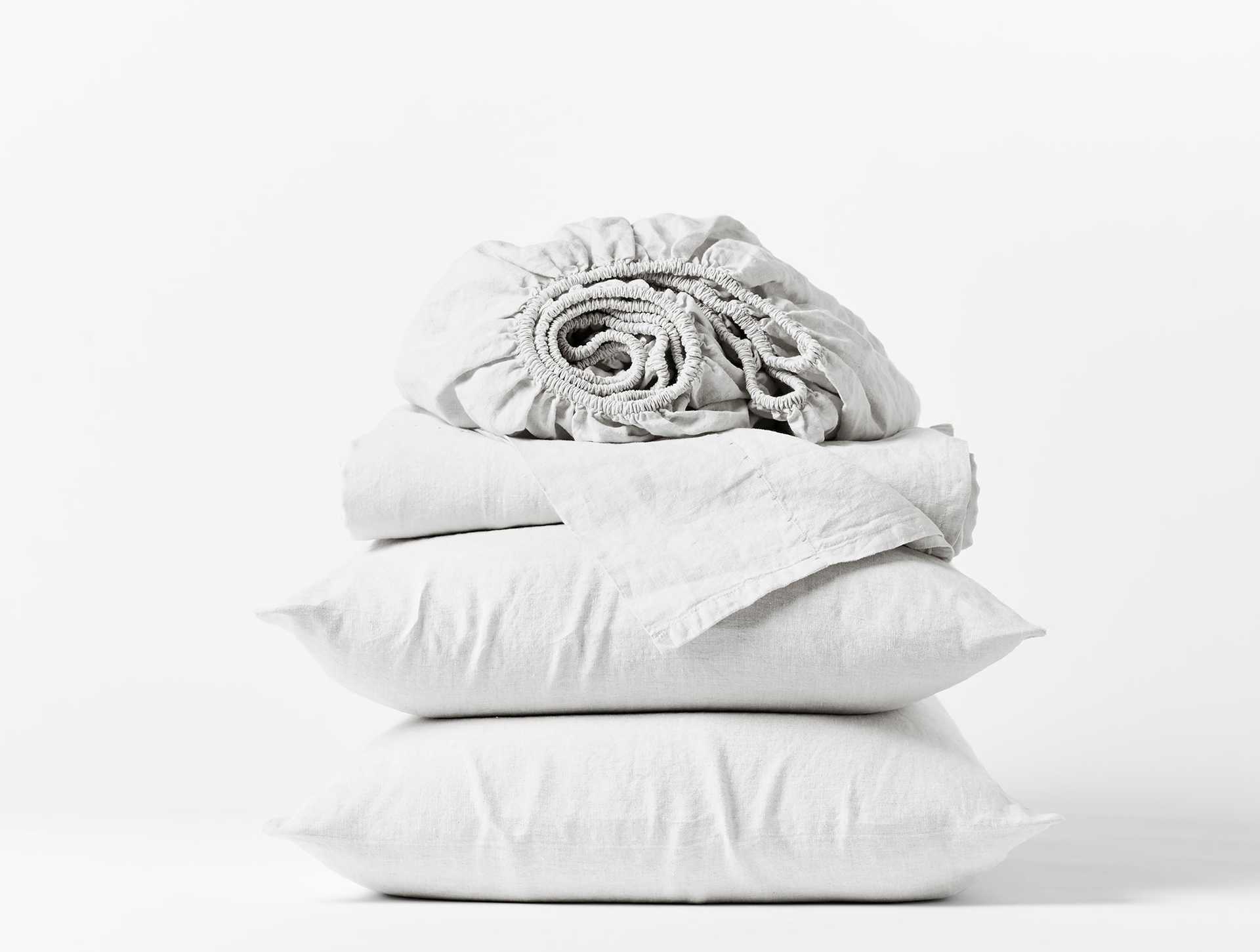
For comparison, the Organic Relaxed Linen Sheet Set listing provides an example of stage-specific sourcing language: it identifies flax grown in France and linen woven in Portugal, alongside product and certification details. That kind of distinction is useful because it clarifies which part of production each place name describes, rather than implying that one location accounts for the entire route.
The bigger picture behind a simple sheet
A sheet looks like one finished object. Its supply chain, however, may connect agricultural land, fiber processors, spinning and weaving facilities, finishing operations, and sewing rooms. Understanding those links does not require becoming a textile specialist. It starts with noticing that a crop’s origin, a fabric’s manufacturing location, and a finished product’s country of origin can be different facts.
That clarity is valuable for consumers and professionals alike. It encourages more careful comparisons, makes certification claims easier to place in context, and helps companies communicate what they know without suggesting that one label explains everything. A country name can open the conversation; the production stage behind it gives the name meaning.
So the next time a linen sheet lists several places, read the details as a route: field, fiber, yarn, fabric, finished bedding. When the description is specific, you can see more of the journey. When it is not, a focused question can help reveal what the label leaves unsaid.